

For decades, sports betting has followed a familiar script: the bookmaker or casino sets the price, and the bettor decides whether to take it. You play against ”the house,” and the house always builds in a margin to ensure its profit. However, a new paradigm is shifting the landscape of speculation: Prediction Markets.
At their core, prediction markets like Polymarket and Kalshi operate less like a traditional casino and more like a stock exchange. Instead of betting against a bookie, you are buying and selling ”shares” in a specific outcome directly with other participants. If you believe a team has a 60% chance of winning, you buy shares at 60 cents; if they win, those shares settle at one dollar.
While Finnish bettors have long been familiar with the peer-to-peer model through the Betfair Exchange, a new wave of platforms has recently captured global headlines. Polymarket, in particular, has emerged as a mainstream powerhouse, often reacting to breaking news and political shifts faster than traditional news outlets or sportsbooks.
By claiming to harness the ”wisdom of the crowd,” these markets are no longer marketing just for niche political junkies — they are becoming the primary source of truth for everything from the next interest rate hike to the winner of the Super Bowl.
The Clash of Models: Efficiency vs. Experience
The fundamental difference between these two worlds lies in who you are playing against. In a traditional sportsbook, you are fighting the ”house edge.” In a prediction market, you are competing against other individuals’ information.
Why Pro-Bettors are Migrating to Markets
For ”sharp” bettors, the allure of platforms like Polymarket or Kalshi is undeniable:
- True Market Prices: Without a bookmaker’s 5–10% ”juice” (vig), prices often reflect the actual probability of an event more accurately.
- No ”Winner Limits”: Traditional sportsbooks are notorious for limiting or even banning successful players. Prediction markets welcome them—more ”sharks” simply mean more liquidity and better price discovery.
- Dynamic Trading: You aren’t locked into a bet. If an NFL quarterback looks shaky in the first quarter, you can sell your ”Yes” shares instantly on the market, potentially cutting your losses or locking in a small profit before the game ends.
Why Traditional Sportsbooks Still Rule the ”Casual” Game
Despite the efficiency of markets, traditional betting sites (check out our list) still remain attractive for the average casual punter:
- Simplicity and Speed: Buying ”event contracts” can feel like stock trading, which can be intimidating. Traditional books offer a ”click and play” experience with instant deposits via services like Trustly or Zimpler.
- Bet Variety: Prediction markets are mostly binary (Yes/No). If you want to bet on a specific NBA player scoring over 28.5 points or build a ”Same Game Parlay,” you still need a traditional sportsbook. (although prediction markets are expanding in this direction)
- Bonuses and Rewards: Prediction markets are neutral exchanges; they don’t offer ”100% deposit bonuses” or ”risk-free bets” that are staples of the casino world.
The Regulatory Tug-of-War
As we move into 2026, the legal status of these markets is a ”new animal” for regulators. While traditional sportsbooks operate under clear, decade-old gambling frameworks (like the MGA in Europe), prediction markets often classify themselves as financial derivatives under federal oversight (CFTC).
However, the tide is turning. Recently, several US states have issued cease-and-desist orders to platforms like Polymarket, arguing that sports-related contracts are ”unlicensed gambling” regardless of the technology used. For the player, this means traditional, licensed sportsbooks still offer far superior consumer protection, including self-exclusion tools and guaranteed payouts that decentralized platforms may lack.
Deep Dive: NBA and NFL Market Dynamics
When we look at high-volume leagues like the NBA and NFL, the technical differences between a traditional sportsbook—such as FanDuel, Bet365, or DraftKings—and a prediction market like Polymarket become very clear.
Betting Options: More than just ”Who Wins?”
While prediction markets started with simple ”Yes/No” outcomes, they have evolved. Today, you can find a variety of contracts:
- Moneyline (Game Winner): The most liquid markets, where you buy shares in a team’s victory.
- Point Spreads: Traditional sportsbooks like Bet365 excel here, but markets now offer ”event contracts” based on whether a team covers a specific spread (e.g., Will the Suns win by 4.5+ points?).
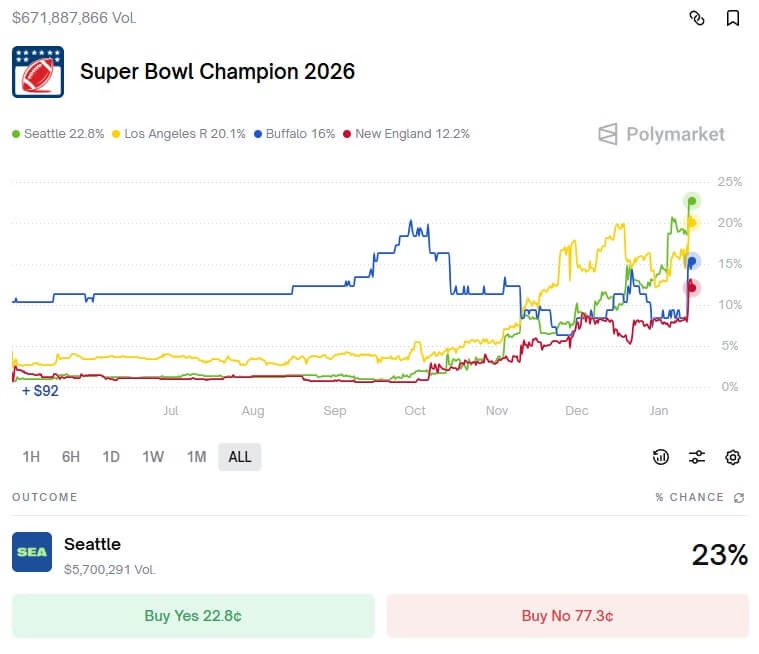
- Championship Futures: High-volume markets for the Super Bowl or NBA Finals winner.
- Player Props: While traditional books offer hundreds of individual player stats (points, rebounds, touchdowns), prediction markets are currently more selective, focusing on major awards like MVP or Rookie of the Year.
The Cost of Betting: Vig vs. Commissions & Spreads
In a traditional sportsbook, the cost is the ”vig” (or juice). For example, a standard spread bet at FanDuel might be priced at -110 on both sides. This means you must bet $110 to win $100; the $10 difference is the house’s guaranteed cut.
Polymarket operates differently, but it isn’t ”free”:
- Fees: Polymarket has recently introduced taker fees on certain markets (and within its mobile app) to fund liquidity rewards. This commission, while often lower than a bookie’s margin, is a direct cost to the trader.
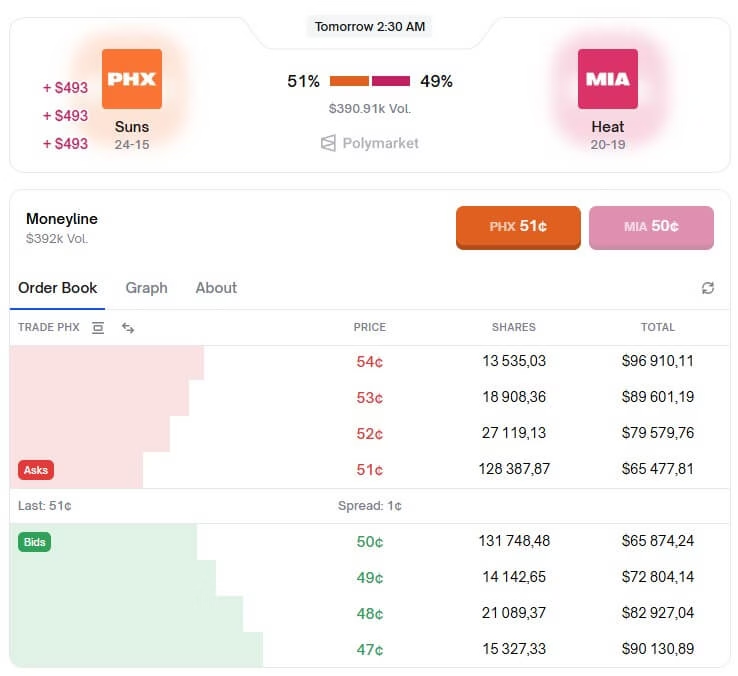
- Liquidity and the Bid-Ask Spread: This is the ”hidden” cost. In high-profile games like the Suns vs. Heat, liquidity is high, meaning the gap between what someone is willing to pay (Bid) and sell for (Ask) is tiny (e.g., 54¢ vs 55¢).
- The Niche Market Trap: However, in less popular sports or specific prop bets, low liquidity can be a problem. If there are few traders, the spread might widen (e.g., 50¢ vs 60¢). In these cases, you might actually pay more to enter a position on a prediction market than you would through the built-in juice of a traditional bookmaker.
Real-Time Case: Phoenix Suns vs. Miami Heat
Looking at tonight’s matchup (Jan 13, 2026):
- Traditional Books: FanDuel and Bet365 have the Suns as slight favorites at -115. To the casual player, this is a simple ”set it and forget it” bet.
- Polymarket: The ”Suns Win” contract is trading at 55¢. For a savvy bettor, this represents an opportunity to ”buy” the Suns at a specific probability. However, one must check the order book: if you want to place a large $10,000 bet in a low-liquidity window, you might ”move the market” and end up buying at an average price of 58¢, effectively losing your edge.
The Finnish Context: Regulation, Taxes, and the Future of Betting
Finland is in the midst of its own historical gambling reform. With the transition toward a local licensing system in full swing, the gap between ”global tech trends” and ”local legal realities” has never been more relevant for Finnish players.
Why Prediction Markets Won’t Be ”Finnish-Licensed”
While the world watches Polymarket for election results, the new Finnish Gambling Act is taking a more conservative path. The upcoming regulatory framework specifically focuses on traditional sports and events, and notably, political and election betting is being excluded from the licensed market.
This means that while these prediction markets are technologically fascinating, they are unlikely to ever receive a Finnish operating license. For a player, this creates several significant hurdles:
- The Tax Hammer: As mentioned earlier, winnings from non-EEA platforms like Polymarket or Kalshi are treated as capital gains in Finland. In 2026, with the new DAC8 reporting requirements, the Finnish Tax Administration has more visibility than ever into crypto-based transactions.
- The Speed Factor: One of the biggest reasons Finnish players use Pikakasinot.fi is the ”Pay N Play” experience. Instant deposits and withdrawals via Finnish banks are a luxury that decentralized global markets simply cannot offer.
- Safety and Responsible Gaming: Finnish-licensed sites (and currently MGA-licensed ones) are required to provide robust self-exclusion tools and localized customer support—protections that are often absent in the ”Wild West” of decentralized event contracts
Prediction markets are a brilliant tool for data and price discovery—they tell us what the world thinks will happen in the NBA or the next election with incredible accuracy. However, for the actual act of betting, the domestic preference remains clear.
For the Finnish bettor who values tax-free winnings, instant bank transfers, and a regulated environment, the curated list of operators here at Pikakasinot.fi remains the most rational choice in 2026.